Bitcoin mining is often associated with industrial-scale farms, professional infrastructure, and large capital investment. For many beginners, this creates the impression that mining is only for big players.
However, the rise of compact solo miners has changed how newcomers can participate in Bitcoin mining. These small devices allow individuals to contribute hashpower directly to the Bitcoin network, even from home.
But that leads to a serious and reasonable question: Can a solo miner really mine Bitcoin, or is it simply a lottery-style gamble? And more importantly, is solo mining a sensible first step for people with limited experience and budget?
This article explains how solo mining works, what results are realistically possible, and when solo mining can be a rational choice.
What Is a Solo Miner and How Does Solo Mining Work?
In Bitcoin mining, miners compete to solve cryptographic puzzles in order to create new blocks. The first miner to find a valid block receives the full block reward and transaction fees.
There are two main ways to participate: pool mining, where miners combine hashrate and share rewards proportionally, and solo mining, where each miner works independently and keeps the full reward if successful.
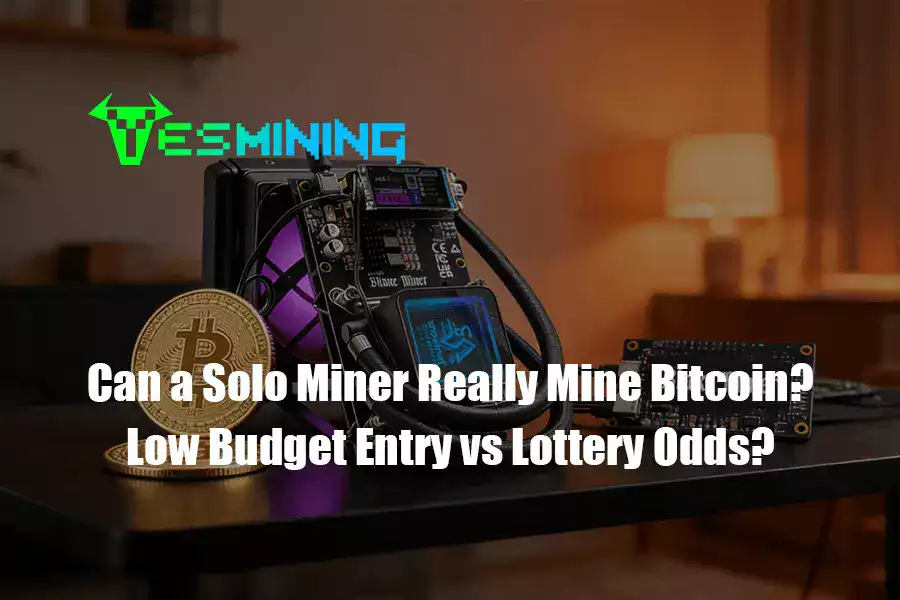
A solo miner device is simply a small ASIC miner configured to mine independently, either by connecting to a solo mining pool interface or running against a personal node.
From a technical standpoint, solo mining follows the same rules and network difficulty as industrial mining. The only real difference is hashrate scale, which directly affects probability.
Is a Solo Miner Worth It for Beginners with Limited Budget?
For newcomers, mining is often more about learning than earning. Typical concerns include high upfront investment, electrical safety, noise and heat management, and uncertain return on investment.
Solo miners significantly reduce these barriers. They are affordable compared to full ASIC miners, extremely low in power consumption, quiet enough for home environments, and simple to configure with basic networking knowledge.
From a learning perspective, solo miners allow beginners to understand wallet and address configuration, observe how hashrate affects mining probability, monitor temperature and stability, and learn real-world mining behavior instead of simulations.
From an educational standpoint, solo miners provide practical mining experience with minimal financial exposure, which is valuable before committing to larger mining equipment.
Solo Mining: Learning Tool or Speculative Gamble?
User intention plays a major role in whether solo mining makes sense. In practice, solo miners are commonly used in two different ways.
Solo Mining as an Entry-Level Learning Platform
Some users approach solo mining strictly as a way to understand mining workflows, test basic hardware operation, and learn software configuration and monitoring.
For these users, success is measured in technical understanding, not Bitcoin earned.
Devices such as Bitaxe Gamma 601 (1.2 TH/s) and Bitaxe GT 800 (2.4 TH/s) are commonly chosen by beginners who want ultra-low power consumption, stable home operation, and simple setup for learning purposes.
If your goal is to explore mining at low cost, these models are ideal starting points. You can find them in the home miner section of our website, where we provide tested units, usage guidance, and compatibility support for beginner setups.
For first-time users, these miners serve as training devices before deciding whether to scale up to professional mining hardware.
Solo Mining as a Probability-Based High-Risk Strategy
Other users are attracted by the mathematical possibility of receiving a full Bitcoin block reward. They understand that the odds are extremely low, that there may be no reward for long periods, and that outcomes cannot be predicted or scheduled.
But they still choose to participate because the cost of entry is relatively low, the potential upside is significant, and they enjoy independent mining without pools.
For this purpose, higher-hashrate solo miners such as NerdQaxe++ (4.8T / 6.1T) and Bitaxe NerdOCTaxe (9.6T) offer better probability compared to entry-level models, while still maintaining low power usage.
These models are typically selected by hobby miners who accept solo mining as a long-term probability experiment, not a guaranteed income source. They are available in our solo miner category, where users can compare hashrate, power efficiency, and setup requirements before purchasing.
In this scenario, solo mining is closer to speculative participation combined with technical hobby interest.
Realistic Success Expectations and Network Difficulty
The global Bitcoin network operates at hundreds of exahashes per second, while most solo miners operate between one and ten terahashes per second.
This means your share of total network power is extremely small, block discovery can take an extremely long time, and there is no guarantee of success regardless of runtime.
From a statistical perspective, the expected financial return of small-scale solo mining is very low and highly unpredictable.
Professional miners rely on pool mining because it converts probability into stable, distributed payouts. Solo mining removes that stability in exchange for independence and full reward ownership.
This trade-off must be clearly understood before purchasing any solo mining device.
Solo Mining vs Pool Mining: Cost and Psychological Differences
Pool Mining with Full ASIC Miners
Pool mining is designed for predictable production. Advantages include regular income distribution, easier profitability modeling, and suitability for business operations.
Challenges include high hardware and infrastructure costs, greater electricity demand, and long-term exposure to market price fluctuations.
Pool mining fits users who treat mining as an operational investment.
Solo Mining with Small Devices
Solo mining prioritizes accessibility and independence. Advantages include low startup cost, minimal power consumption, easy home deployment, and no reliance on pool operators.
Challenges include no stable income, success depending purely on probability, and return on investment that cannot be calculated reliably.
Solo mining fits users who treat mining as a learning process or hobby-level experiment rather than a financial plan.
When Does Solo Mining Make Sense?
Reasonable Scenarios for Solo Mining
Solo mining is suitable when you are new and want hands-on experience, want to understand mining before investing heavily, have limited budget but strong curiosity, and value learning over immediate profit.
In these cases, solo miners function as educational gateways into the mining ecosystem.
Situations Where Solo Mining Is Not Recommended
Solo mining may not be appropriate if you depend on mining for steady income, expect predictable monthly returns, plan to scale mining operations quickly, or cannot tolerate long periods of zero reward.
In these scenarios, pool mining with proper ASIC hardware is far more practical and financially structured.
Final Thoughts: Lottery Ticket or First Step into Mining?
So, can a solo miner really mine Bitcoin? Yes, solo miners do occasionally find blocks. But no, solo mining does not provide stable or predictable income.
The real value of solo miners lies in low-cost technical education, direct participation in Bitcoin’s network, and optional exposure to rare but meaningful rewards.
For beginners, a solo miner can be a practical learning platform, a low-risk introduction to mining, and a bridge between curiosity and serious investment.
When approached with realistic expectations, a solo miner is not just a lottery ticket. It can be a responsible and educational first step into the world of Bitcoin mining.




























 Bitmain
 Iceriver
 Bitdeer
 BOMBAX
 DragonBall
 Elphapex
 Fluminer
 Goldshell
 iBelink
 Ipollo
 Jasminer
 Volcminer
 Bitcoin(BTC) Miner
 Aleo Miner
 CKB Miner
 ETC Miner

 Kaspa(KAS) Miner


 Siacoin(SC) Miner