Table of Contents
1. Industry Inflection Point: ASICs Re-enter the Monero Mining Pool
Since the launch of the RandomX algorithm in 2019, Monero (XMR) mining has been considered the “exclusive domain” of CPUs, designed to resist ASICs and maintain network decentralization. However, technological evolution never stops. According to authoritative industry information from sources like ASIC Miner Value, Bitmain plans to release the Antminer X9, specifically designed for the RandomX algorithm, in July 2026. This marks a potential inflection point in the Monero mining ecosystem, signaling a possible transition of mining activity from consumer-grade hardware to more efficient, specialized equipment.
2. Antminer X9 Technical Specifications and Performance Decoded
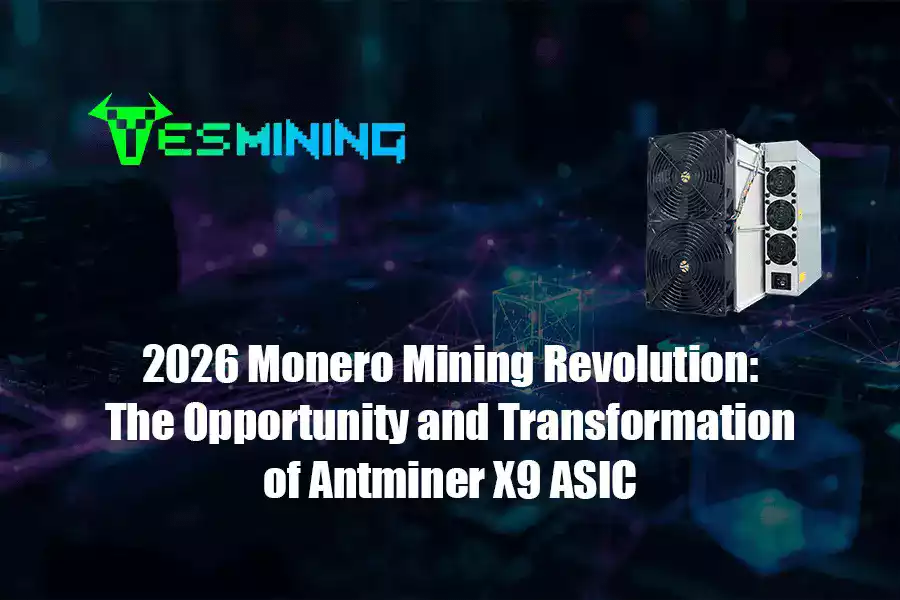
The Antminer X9 is not a simple upgrade of existing equipment but a newly designed professional ASIC miner tailored for the RandomX algorithm. Its core parameters reveal a huge performance leap:
Hashrate: 1 Mh/s (i.e., 1,000,000 H/s)
Power Consumption: 2472W
Power Efficiency: 2.472 J/KH
Status: Expected release in July 2026
Other Parameters: Operating voltage 220-277V, noise level ~76dB, weight 17.5kg.
Performance Comparison Perspective:
To intuitively understand the change brought by the X9, we compare it with current top-tier CPU mining setups:
| Device Type | Hashrate (Approx.) | Power Draw (Approx.) | Efficiency (J/KH) | Notes |
|---|
| Antminer X9 (ASIC) | 1,000,000 H/s | ~2472W | ~2.47 | Professional single unit |
| High-end CPU (e.g., AMD Ryzen 9) | ~20,000 H/s | ~180W | ~9.00 | Requires full computer host |
The comparison shows that the hashrate of a single Antminer X9 is equivalent to the sum of dozens of high-end CPUs, while its power efficiency (lower value is better) is several times superior. This means the X9 will significantly save on electricity costs and space to achieve the same hashrate.
3. 2026 Mining Profitability: A Precise Model Based on the X9
The core decision for professional miners is Return on Investment (ROI). Based on calculator data from ASIC Miner Value (assuming an electricity cost of $0.10 per kWh and a relatively stable Monero price), we estimate the expected revenue for the Antminer X9:
| Item | Daily | Monthly | Annually |
|---|
| Estimated Revenue | $27.88 | $836.45 | $10,176.84 |
| Electricity Cost | -$5.93 | -$177.98 | -$2,165.47 |
| Estimated Profit | $21.95 | $658.47 | $8,011.36 |
Key Profitability Variables:
* Electricity Cost: This is the largest operational variable. The table above is calculated based on $0.10/kWh. If you can obtain industrial electricity rates below $0.06/kWh, profits will increase significantly; if above $0.15/kWh, profit margins will be severely compressed.
* Network Hashrate & Difficulty: With the gradual deployment of high-performance ASICs like the X9, Monero’s total network hashrate is expected to surge, causing mining difficulty to rise sharply, and thus reducing the reward per unit of hashrate for individual miners. The “Estimated Revenue” in the table above is based on the current network state; actual future revenue may decrease.
* Equipment Cost & Coin Price: The purchase cost of the miner itself (reportedly around $5,495 according to the page info) and the market price of Monero are the most critical factors determining the payback period.
4. Economic and Ecological Impact of the ASIC Era
The entry of the Antminer X9 could profoundly change the Monero mining landscape:
* Efficiency Gains vs. Centralization Risk: Professional ASICs elevate mining efficiency to new heights but may concentrate hashrate in the hands of well-capitalized miners or pools, which contradicts RandomX’s original goal of resisting ASICs to maintain decentralization.
* Potential Community Response: The Monero community has historically performed hard forks to resist ASICs. Whether the community will choose to modify the algorithm again in response to the X9 is a significant unknown, also representing the greatest policy risk for investing in ASIC mining.
* Changing Investment Threshold: Mining transitions from “participating with idle computer time” to a clear investment in professional equipment, raising the barrier to entry and requiring more rigorous business planning for decisions.
5. Deploying the Antminer X9: Practical Guide and Considerations
If you are considering deploying the Antminer X9, here are the key points:
1. Power Infrastructure: With a single device consuming nearly 2500W, ensure the mining site has sufficient circuit capacity for 220V or above, a reliable power distribution system, and a cooling solution (76dB noise requires isolation).
2. Cost and Return Calculation: Precisely calculate the total investment including miner cost, shipping, electricity, hosting (if applicable), and dynamically evaluate the payback period under expected hashrate growth.
3. Risk Management: The “potential for a community hard fork rendering the device obsolete” must be considered as the highest-level risk. Do not invest capital you cannot afford to lose entirely.
4. Supplier Selection: For such high-value, cutting-edge professional equipment, choosing a trustworthy supplier is crucial. For example, professional platforms like Yesminer.io, which provide one-stop services from procurement and logistics to after-sales support, can offer reliable protection for miners, reducing the complexity and risks of initial deployment.
6. Conclusion: Embracing the Future of Professional Mining
The emergence of the Antminer X9 paints a picture of high efficiency but also significant challenges for Monero mining in 2026 and beyond. It represents indisputable technological progress, but also poses serious tests for the network’s decentralization philosophy and miners’ risk management capabilities.
For miners, this is no longer a simple question of “whether to participate,” but a strategic decision requiring precise calculation, risk assessment, and thorough infrastructure preparation. In the new era of mining that ASICs may reshape, success will belong to those participants who both respect technological trends and deeply understand community dynamics and financial risks.



























 Bitmain
 Iceriver
 Bitdeer
 BOMBAX
 DragonBall
 Elphapex
 Fluminer
 Goldshell
 iBelink
 Ipollo
 Jasminer
 Volcminer
 Bitcoin(BTC) Miner
 Aleo Miner
 CKB Miner
 ETC Miner

 Kaspa(KAS) Miner


 Siacoin(SC) Miner