While industrial mining operations dominate headlines, Bitcoin mining remains remarkably accessible for individual enthusiasts in 2025. Contrary to popular belief, over 38% of new miners this year are starting with modest sub-$1,000 setups, proving you don’t need massive capital to participate meaningfully in blockchain security.
| Mining Setup Type | Cost Range (USD) | Description |
|---|
| Single GPU Rig | $400 – $1000 | Beginner-friendly setup using 1-2 GPUs (e.g., RTX 3070), best for altcoins |
| Entry-Level ASIC | ~$2000 | Budget Bitcoin miners including Solo Miners and some home ASIC miners such as Avalon Q |
| High-End ASIC Miner | ~$4600 | Industrial-grade miners (e.g., Antminer S21), requires professional setup |
Most people join mining pools or mine at home for less money. Some use the heat from mining to warm their homes. Others try solo “lottery mining” to win big prizes. How well you do with crypto mining depends on power costs, your gear, and bitcoin’s price. People who mine should care about saving energy and handling risks. Cheap crypto mining works best when miners are smart and plan well.
Key Takeaways
You can start bitcoin mining with little money. Pick cheap hardware like a single GPU rig or a small ASIC miner. Join good mining pools to get rewards often.
Save money by finding low-cost electricity. Take care of your equipment so it lasts longer. Use free or cheap mining software and wallets to spend less.
Keep your money safe by staying away from scams. Use strong security to protect your stuff. Write down all your costs. Think of mining as a way to learn over time, not a fast way to get rich.
Bitcoin Mining Basics
What You Need to Start
If you want to mine bitcoin without spending much, you need a few things. You must have cheap hardware, mining software, and a safe wallet. For hardware, you can use basic GPUs or small miners. You also need a power supply, fans, and surge protectors to keep things safe. A good router helps your mining stay online. Most people use free mining software to run their mining. You need a wallet to keep your bitcoin safe. Wallets can be on your computer or a special device. The whole setup can cost between $500 and $2,000, based on what you buy.
Budget Hardware Options
Cheap hardware is important for mining bitcoin with little money. Basic GPUs, like the EVGA GeForce RTX 3070 Ti, work well and do not cost too much. Small ASIC miners, like the Canaan Miner Avalon Q, are another choice for bitcoin mining. These use less power and are cheaper than big ASIC miners. Big ASIC miners cost more and need better cooling, so they are not great for small budgets. Most people who want to save money pick GPUs or small ASIC miners because they are cheaper and easier to use.
Mining Software and Wallets
Mining software helps your hardware talk to the bitcoin network. EasyMiner and NiceHash are good for beginners and are simple to use. Many mining programs are free, so you do not spend extra money. You need a wallet to hold your bitcoin. There are two main types: hot wallets and cold wallets. Hot wallets are free but not as safe. Cold wallets, like Ledger, cost about $100 to $200 and keep your bitcoin safer. Picking the right software and wallet is important if you want to mine bitcoin without spending too much.
Mining Methods for Beginners
Mining can look hard for beginners, but there are easy ways to start. Each way has its own cost, risk, and how much you might earn. The most common ways are pool mining, solo mining, cloud mining, and using gaming PCs or USB miners.

Pool Mining
Pool mining lets many miners work together. This helps them win block rewards more often. Rewards are split by how much each miner helps. Pools use payout systems like Pay-Per-Share (PPS), Full-Pay-Per-Share (FPPS), or Pay-Per-Last-N-Shares (PPLNS). PPS is good for new miners because it pays steady rewards. You do not need strong hardware for pool mining. Even one GPU or a small miner can join a pool. Pools charge fees, usually from 1% to 5%. These fees help pay for running the pool.
Pool Mining vs. Solo Mining: Key Differences
| Aspect | Solo Mining (Low-Budget User) | Pool Mining (Low-Budget User) |
|---|
| Earnings Stability | Unpredictable, long waits for block rewards | Steady, frequent mining rewards |
| Hardware Investment | Requires expensive ASICs or choose Solo lottery Miners | Flexible device options (from GPUs to all-level ASICs) |
| Mining Difficulty | Very high, low chance of earning rewards | Lower, as pools combine hash power |
| Costs | Full electricity and maintenance | Shared costs, pool fees apply |
| Risk | High risk, possible no rewards for months | Lower risk, regular payouts |
Steps to Join a Mining Pool
Pick a trusted mining pool with low fees and strong security.
Sign up on the pool’s website and make an account.
Set up your mining gear and connect it to the internet.
Get mining software and add the pool’s stratum address.
Connect your cryptocurrency wallet to get your rewards.
Start mining and check your earnings on the pool’s dashboard.
Cloud Mining
Cloud mining lets people rent mining power from companies. You do not need to buy hardware or keep it at home. Beginners can start with little money and mine bitcoin from anywhere.
How Cloud Mining Works
Cloud mining companies run big mining farms. Users buy contracts for a set amount of hash power. The company mines bitcoin and sends rewards to the user’s wallet. In 2025, MiningCoop, ECOS, and MultiMiner are popular choices. Contracts can cost from $1 to $200 or more. Daily returns change based on the provider.
Pros and Cons of Cloud Mining for Beginners
Pros:
No need to buy or fix hardware.
Cheap crypto mining with flexible contracts.
You can mine from anywhere with internet.
Easy setup and possible passive income.
Cons:
Mining rewards are lower because of fees and upkeep.
There is a high risk of scams and bad companies.
You have less control over mining.
Some contracts may not make money.
Profit, Costs, and Risks
| Parameter/Input |
Description |
| Hash Rate |
Power of mining hardware |
| Hardware Costs |
Money spent on equipment |
| Electricity Costs |
Power bills for running miners |
| Mining Pool Fees |
Fees charged by mining pools |
| Bitcoin Price |
Current price of bitcoin |
| Network Difficulty |
How hard is it to mine a block |
| Block Reward |
Bitcoins earned for each block |
| Projections |
Future changes in difficulty and rewards |
Using Mining Calculators
A good calculator lets you change numbers to see what happens. Miners should remember to add hardware wear, power bills, pool fees, and taxes when checking profit.
Managing Electricity and Setup Costs
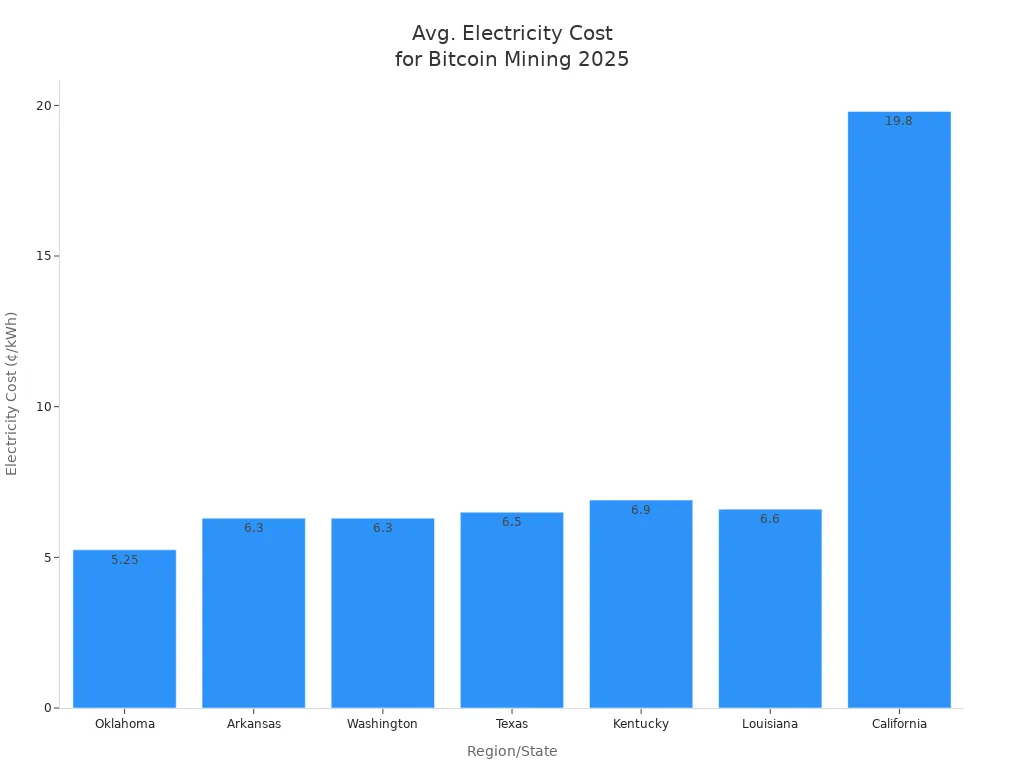
Electricity is the biggest cost for people who want to mine. In 2025, miners in Oklahoma or Arkansas will pay less for power. Miners in California pay much more for electricity. The chart below shows average power costs in different U.S. places:
Risks in Crypto Mining
Tips for Success on a Budget
Pick good hardware and join safe mining pools for steady rewards.
Track all costs, like power, hardware, and pool fees, to avoid surprises.
Use a backup internet and strong security to keep your crypto safe.
Think about other choices like mining stocks or holding bitcoin, if mining feels too risky.
Treat mining as a way to learn and focus on long-term profit, not fast rewards.
Recommended Solo Home Mining Devices
For solo home mining, devices like the Antminer S21 or Whatsminer M63 work well for those who want to invest in crypto mining. Used ASICs can make mining cheaper, but check for warranty and condition. Always compare rewards, costs, and risks before you invest in crypto mining.
FAQ
What is the easiest way to start Bitcoin mining on a low budget?
Beginners can join a mining pool with a single GPU or try cloud mining. These methods need less money and offer steady rewards.
How can someone avoid scams in cloud mining?
What's the biggest risk for budget Bitcoin miners?
Electricity costs pose the greatest risk – even a $500 ASIC miner will lose money if your power rate exceeds $0.12/kWh. The key to protecting your investment is calculating your break-even power costs and closely monitoring network difficulty trends.
Should I mine Bitcoin or altcoins with a small budget?
For better returns, diversify: mine Bitcoin for stability (via pools) and altcoins for higher potential gains. Small GPUs can profitably mine coins like Monero or Ravencoin, while Bitcoin requires ASICs. Balance both to spread risk and opportunities.
























 Bitmain
 Iceriver
 Bitdeer
 BOMBAX
 DragonBall
 Elphapex
 Fluminer
 Goldshell
 iBelink
 Ipollo
 Jasminer
 Volcminer
 Bitcoin(BTC) Miner
 Aleo Miner
 CKB Miner
 ETC Miner

 Kaspa(KAS) Miner


 Siacoin(SC) Miner