In the highly volatile world of cryptocurrency, market sentiment often drives price movements more than fundamentals. The Crypto Fear & Greed Index provides a real-time snapshot of this collective emotion. When optimism prevails, prices tend to rally; when fear takes over, they often plummet. Understanding these shifts can help you make smarter, more disciplined investment decisions.
This piece will discuss the Index’s definition, operation, and significance, offering actionable strategies for its use.
Key Takeaways
- The Crypto Fear & Greed Index shows how people feel about the market. Low scores mean fear, while high scores mean greed.
- Use the index to time your trades. Buy when fear is high (scores 0-24) and sell when greed is high (scores 75-100).
- Combine the index with other tools for better decisions. This helps you avoid mistakes and make smarter investments.
Crypto Fear & Greed Index Basics
The Crypto Fear & Greed Index quantifies market sentiment, indicating whether investors are driven by fear or greed. It serves as a psychological barometer, helping traders gauge the overall mood and anticipate potential market movements. If the score is low, fear is strong in the market. If the score is high, greed is stronger.
How Does It Works
The Crypto Fear & Greed Index uses different things to make its score. It looks at volatility, market momentum and volume, social media activity, Bitcoin dominance, and Google Trends.
Each thing matters a different amount. Volatility and market momentum/volume each count for 25% of the score. Social media counts for 15%. The index changes every day to show the newest market mood.
The Crypto Fear & Greed Index helps investors see market changes. Very high or low scores can happen before big price moves. In 2017, the index showed high greed when Bitcoin was close to $20,000. After that, the market dropped a lot. In March 2020, the index showed strong fear, and Bitcoin went up soon after. Investors use this index to guess when prices might be highest or lowest.
Beyond trading, the Crypto Fear & Greed Index also helps gauge how efficient crypto mining is. The crypto ecosystem isn’t just about trading—Bitcoin mining is its core, and whether mining makes money depends a lot on market conditions. The Fear & Greed Index shows these conditions clearly.
When fear is strong (index 0-20) and crypto prices drop, mining profits shrink. Costs like energy, hardware upkeep, and operations can quickly overtake earnings. Only the most efficient miners—those with cheap renewable energy or top-tier hardware—can stay profitable. Less efficient miners may have to shut down or sell their gear, which lowers the network’s overall hash rate.
Why It Matters
On the other side, when greed takes over (index 81-100) and prices jump, mining becomes easier to profit from. Even mines with higher costs can make money, so more miners join the network, and the hash rate goes up. For mining companies or people investing in mining-related assets, tracking the Fear & Greed Index helps predict changes in industry competition and profitability.
Using the Index for Investment Decisions
Interpreting Scores
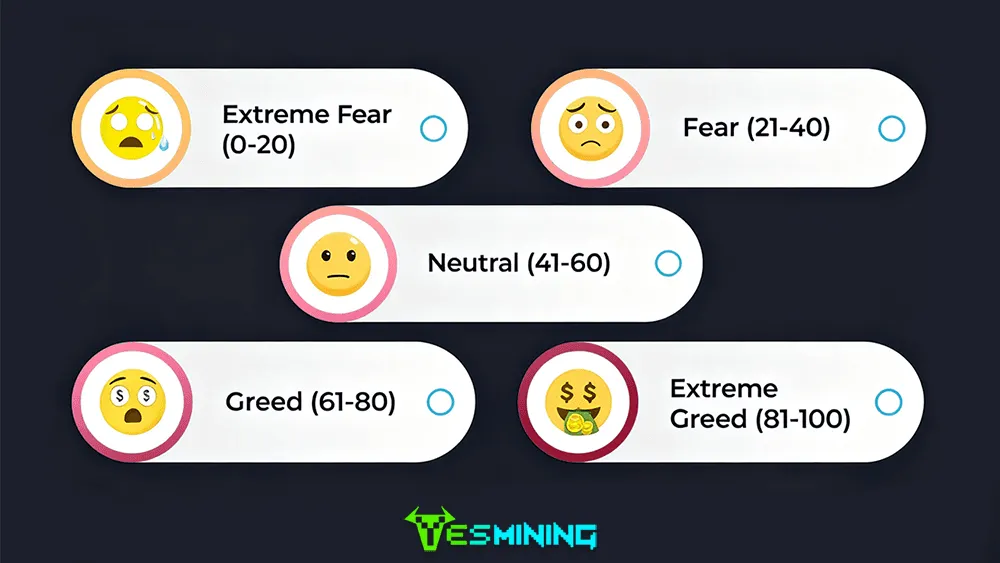
The Crypto Fear & Greed Index helps investors see how people feel. Scores go from 0 to 100. Each score range means something about the market mood.
Low scores mean many people feel worried. High scores mean most people feel sure or very excited. Extreme fear can mean assets are worth less than normal. Extreme greed can mean the market is too expensive.
Timing Trades
Investors use the Crypto Fear & Greed Index to find good times to buy or sell. The index shows when people are too scared or too greedy.
In 2021, the index showed extreme fear during the crypto crash. Some people bought coins at low prices and made money when prices went up. In 2017, the index showed extreme greed before Bitcoin prices dropped. In March 2025, Solana’s index went up after a network upgrade. Traders used this signal to buy before prices jumped.
Index Reading | Market Condition | Correlation with Price Trends |
|---|
0-20 (Extreme Fear) | Market panic and potential capitulation. Assets are likely severely undervalued. Mining profitability plummets; only efficient operations survive. | Often coincides with market bottoms. Presents a potential buying opportunity for a price rebound. |
21-40 (Fear) | Pessimistic sentiment prevails. Investors are cautious and risk-averse. Mining margins tighten; less efficient miners may pause operations. | Downtrend or consolidation may be ending. Selling pressure could be weakening. |
41-60 (Neutral) | Sentiment is balanced. There is no strong bias towards greed or fear. Mining profitability stabilizes; network hash rate holds steady. | Price direction is uncertain; the market is often in a ranging or transitional state. |
61-80 (Greed) | Optimism and confidence are growing. FOMO (Fear Of Missing Out) may begin to appear. Mining becomes more profitable; new miners enter the network, raising hash rate. | Typically accompanies rising prices and bullish momentum. Caution is advised as risk increases. |
81-100 (Extreme Greed) | Market euphoria and irrational exuberance. Assets are likely overvalued. Mining profitability peaks; even high-cost operations thrive (risk of overcapacity). | Often signals a market top. Suggests a strong potential selling signal with a high risk of a sharp correction. |
Combining With Other Tools
Professional traders do not use the Crypto Fear & Greed Index alone. They use it with other tools to check market signals.
| Technical Analysis Tool | Description |
|---|
| Relative Strength Index (RSI) | Checks how fast prices change to spot if something is too expensive or too cheap. |
| Money Flow Index (MFI) | Shows if people are buying or selling by looking at price and volume. |
| Stochastics | Compares closing prices to a range over time. |
| Williams %R | Checks if prices are too high or too low. |
Traders want the index and other tools to agree. If both say it is a good time to buy, they feel better about their choice. Sometimes, the index and price move in different ways. This can mean the market might change soon.
Watch for differences between the index and price moves.
Use the index with data like trading volume and liquidity.
Mix the index with moving averages or exchange flows for stronger signals.
Pros and Cons of the Crypto Fear & Greed Index
Like any analytical tool, the Crypto Fear & Greed Index has both advantages and limitations. Understanding these can help investors use it more effectively within a broader trading strategy.
Pros:
Measures Market Sentiment Quantitatively:
The index translates crowd psychology into a clear numerical value (0–100), helping traders gauge whether the market is driven by fear or greed.
Supports Emotion-Aware Decision-Making:
It encourages data-based decisions rather than emotional reactions. Investors can avoid FOMO (fear of missing out) or panic selling by referring to objective sentiment indicators.
User-Friendly and Accessible:
The index is straightforward, updated daily, and easily accessible online, making it practical for both new and experienced traders.
Historical Context:
Access to historical data allows users to identify patterns and correlate past sentiment extremes with market reversals.
Helps in Timing Entries and Exits:
Low values (0–24) often signal potential buying opportunities, while high values (75–100) may suggest overbought conditions and a good time to take profits.
Improves Risk Management:
By recognizing sentiment extremes, traders can better manage risk and diversify entries instead of investing all at once.
Cons:
Not a Standalone Predictor:
The index should not be used alone. It doesn’t guarantee market reversals and is not a substitute for fundamental or technical analysis.
Can Remain Extreme for Extended Periods:
During prolonged bull or bear markets, the index can stay in “extreme greed” or “extreme fear” territories for longer than expected, potentially leading to premature entries or exits.
Lagging and Composite Nature:
Since it aggregates data from multiple sources (volatility, social media, etc.), it may not capture real-time shifts quickly enough for very short-term trading.
False Signals Possible:
Like all indicators, it can occasionally give misleading readings, especially in atypical market environments or during low-liquidity events.
Investors can avoid making choices based on feelings by using the index with a plan. Setting stop-loss and take-profit levels helps control risk. Buying a little at a time and owning different coins protects against big changes. Long-term investors should use the index to learn about market mood but stick to their plans.
The Crypto Fear & Greed Index is a valuable tool for identifying market trends and managing risk. When used in conjunction with other analytical methods, it can significantly enhance decision-making and help investors navigate the crypto markets with greater confidence.Traders who use research and look at market feelings do well. They often make smarter choices. They also avoid mistakes from strong feelings. This way, investing is more balanced and smart.
FAQ
What does the Crypto Fear & Greed Index measure?
The index measures market sentiment on a scale from 0 to 100, reflecting whether investors are primarily driven by fear (low values) or greed (high values). It aggregates data from sources like volatility, trading volume, social media, and search trends to quantify the emotional state of the crypto market.
How often does the Crypto Fear and Greed Index update?
The index is updated daily, providing a timely snapshot of market sentiment that traders can use to inform their short and long-term strategies.
Can the index predict market movements?
While the index can signal potential turning points—such as extreme fear indicating a buying opportunity or extreme greed suggesting a market top—it is not a predictive tool. It should be used in combination with other forms of analysis like technical indicators and fundamental research.
Is the index suitable for beginner investors?
Yes, its simple 0–100 scale makes it intuitive. However, beginners should use it as one of several tools and prioritize learning about risk management, diversification, and market analysis before making significant trades.
What are the limitations of the Fear & Greed Index?
The index shouldn’t be used in isolation. It can sometimes give false signals or remain at extreme levels for extended periods. It also doesn’t account for external events such as regulatory news or macroeconomic shifts, which can suddenly change market dynamics.































 Bitmain
 Iceriver
 Bitdeer
 BOMBAX
 DragonBall
 Elphapex
 Fluminer
 Goldshell
 iBelink
 Ipollo
 Jasminer
 Volcminer
 Bitcoin(BTC) Miner
 Aleo Miner
 CKB Miner
 ETC Miner

 Kaspa(KAS) Miner


 Siacoin(SC) Miner