Key Takeaways
-
Miners under 1800W tend to offer more stable long-term performance in home environments than high-power industrial units.
-
For home users, efficiency per watt and consistent noise levels usually matter more than chasing peak hashrate.
-
Simple setup optimizations like airflow direction, proper circuit planning, and off-peak operation— can noticeably improve real-world efficiency over time.
Over the past year, we’ve seen a clear shift in our customer conversations. More home users are asking the same question:
Can I mine crypto at home without increasing my electric bill too much?
Electricity bills are rising, regulations are tightening in some areas, and most people aren’t looking to turn a spare room into a high-consumption, high-noise operation. For home users, efficiency and practicality matter more than raw power.
In this guide, we break down four low-power miners that we’ve seen perform reliably in real home setups. We compare their hashrate, power consumption, and overall usability based on what actually works in residential settings.
If you’re planning to mine Bitcoin, Dogecoin, or other cryptocurrencies at home, this article will help you determine which machine fits your environment and how to configure it for better efficiency.
Table of Contents
Why Low-Power Crypto Mining Matters in 2026
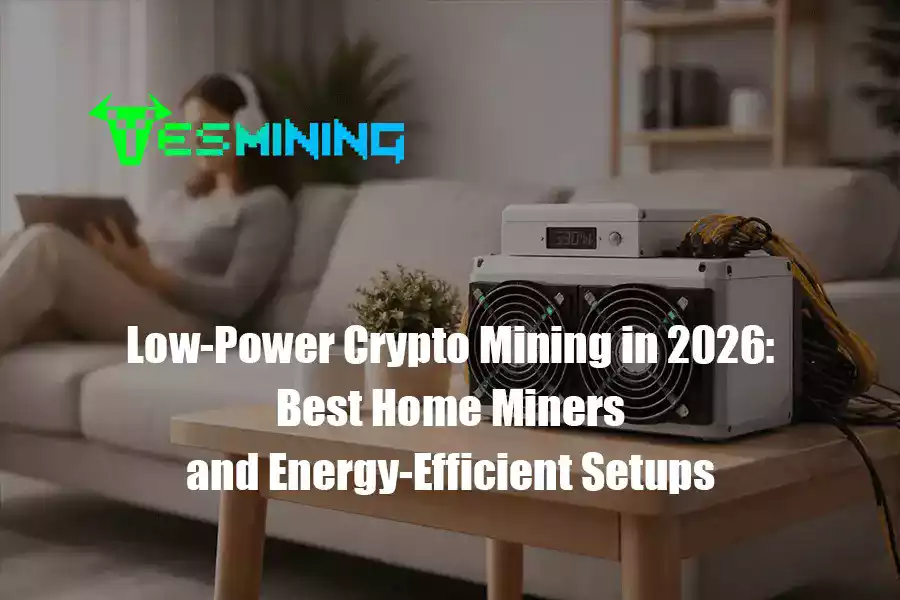
In our past customer support cases, we’ve observed a consistent trend: home users prefer stable systems below 1800W to high-power industrial hardware.
Large industrial mining farms still dominate the total network hashrate. But for individual miners running equipment at home, efficiency and manageability have become the priority.
In practical terms, low-power mining offers several clear advantages:
- Lower electricity bills and predictable operating costs
- Reduced heat and noise for residential environments
- Improved long-term hardware durability
- Greater flexibility across regions with higher power prices
For home users, these factors often matter more than pushing maximum hashrate.
What Defines a Good Home Mining Setup?
From what we’ve seen supporting home users, performance alone isn’t enough. If a miner overheats a small room or pushes household wiring too hard, it quickly becomes difficult to manage.
Unlike industrial farms, home miners need equipment that works within everyday residential limits. That usually means:
- Power Consumption: Typically under 2000W per unit
- Noise Levels: Quiet or manageable without soundproofing
- Heat Output: Compatible with residential ventilation
- Electrical Compatibility: Standard household voltage
The miners featured in this guide are selected specifically for these criteria.
Best Low-Power Bitcoin Miners for Home Use
Bitcoin mining at home is still possible in 2026 — but hardware selection makes a significant difference.
For most residential setups, the focus is no longer on extreme power draw. Instead, it’s about finding machines that deliver solid efficiency while staying within safe and manageable operating conditions.
Avalon Q 90Th/s – Balanced Efficiency for Home Bitcoin Mining
Based on our customer cases over the past year, the Avalon Q 90Th/s is commonly selected by miners looking for stable Bitcoin mining while keeping power consumption within what a home circuit can comfortably handle.
- Hashrate: 90 Th/s
- Power Consumption: 1674W
- Algorithm: SHA-256
At around 1674W, it stays within a range that many residential setups can manage without additional electrical modifications. For users prioritizing long-term stability over chasing maximum hashrate, this model is generally a practical choice.
Learn more about Avalon Q 90Th/s specifications
Fluminer T3 115Th/s – High Hashrate, Home-Friendly Design
From what we’ve seen in residential setups, the Fluminer T3 115Th/s is often considered by users who want more Bitcoin output while still staying under typical home power thresholds.
- Hashrate: 115 Th/s
- Power Consumption: 1700W
- Optimized for silent home operation
At around 1700W, it remains within a range that many home environments can support, while offering noticeably higher hashrate compared to mid-tier models.
For miners who want a step up in performance without crossing into industrial-level power consumption, this model represents a reasonable middle ground.
Learn more about Fluminer T3 specifications
Best Low-Power Dogecoin & Litecoin Miners
Scrypt mining has steadily grown in popularity among home miners. It works well in residential setups because the hardware is relatively easy to manage and flexible to deploy. Dogecoin and Litecoin mining rigs are often easier to fit into small spaces, letting users keep electricity use in check while still earning consistent rewards.
Fluminer L3 9.5Gh/s – Stable Scrypt Mining at Home
The
Fluminer L3 9.5Gh/s is a reliable option for home-based Dogecoin and Litecoin mining.
- Hashrate: 9.5 Gh/s
- Power Consumption: 1700W
- Algorithm: Scrypt
At this power level, it works well in most residential setups while delivering steady performance over long periods.
Learn more about Fluminer L3 specifications
ElphaPex DG2 Mini 2.4Gh/s – Ultra-Low Power Scrypt Miner
The ElphaPex DG2 Mini 2.4Gh/s is frequently selected by home users with strict power limits or limited space, such as apartments.
- Hashrate: 2.4 Gh/s
- Power Consumption: 530W
- Ultra-compact and quiet
Its low power draw makes it easier to run in small rooms or setups without dedicated circuits, while still providing a practical introduction to Scrypt mining.
Learn more about ElphaPex DG2 Mini specifications
Comparison: Which Low-Power Miner Should You Choose?
Your ideal miner depends on your goals:
- Entry-Level / Ultra Low Power: ElphaPex DG2 Mini
- Scrypt Performance Focus: Fluminer L3
- Balanced Bitcoin Mining: Avalon Q 90Th/s
- Higher Bitcoin Hashrate at Home: Fluminer T3
Energy-Efficient Setup Tips for Home Mining
To maximize efficiency:
- Use dedicated circuits where possible
- Optimize ventilation to reduce fan load
- Monitor temperature and power usage regularly
- Consider off-peak electricity rates
Small optimizations compound significantly over time.
Where to Buy Reliable Home Mining Hardware
Using verified hardware helps reduce setup issues and improves long-term stability. YesMining offers miners tested for home use, providing consistent performance and compatibility with standard residential circuits. For more details on available models, technical specifications, and practical setup guidance,
visit YesMining official shop
Disclaimer: Mining profitability depends on electricity costs, network difficulty, and market conditions. Always perform your own calculations before purchasing hardware.























 Bitmain
 Iceriver
 Bitdeer
 BOMBAX
 DragonBall
 Elphapex
 Fluminer
 Goldshell
 iBelink
 Ipollo
 Jasminer
 Volcminer
 Bitcoin(BTC) Miner
 Aleo Miner
 CKB Miner
 ETC Miner

 Kaspa(KAS) Miner


 Siacoin(SC) Miner