What are the best ways to boost crypto mining profitability in 2025?
Choose efficient asic hardware for bitcoin mining.
Lower electricity costs and monitor market changes.
Join a mining pool for steady profits.
Follow operational efficiency tips.
Track the best crypto to mine with asic miner upgrades.

Key Takeaways
Choose efficient ASIC mining hardware with high hash rates and low power use to save electricity costs and boost profits.
Join a mining pool to earn steady and predictable rewards instead of waiting long periods for solo mining payouts.
Track market trends and use profitability calculators regularly to pick the best crypto to mine and adjust your strategy.
Efficient Hardware
Hardware Efficiency
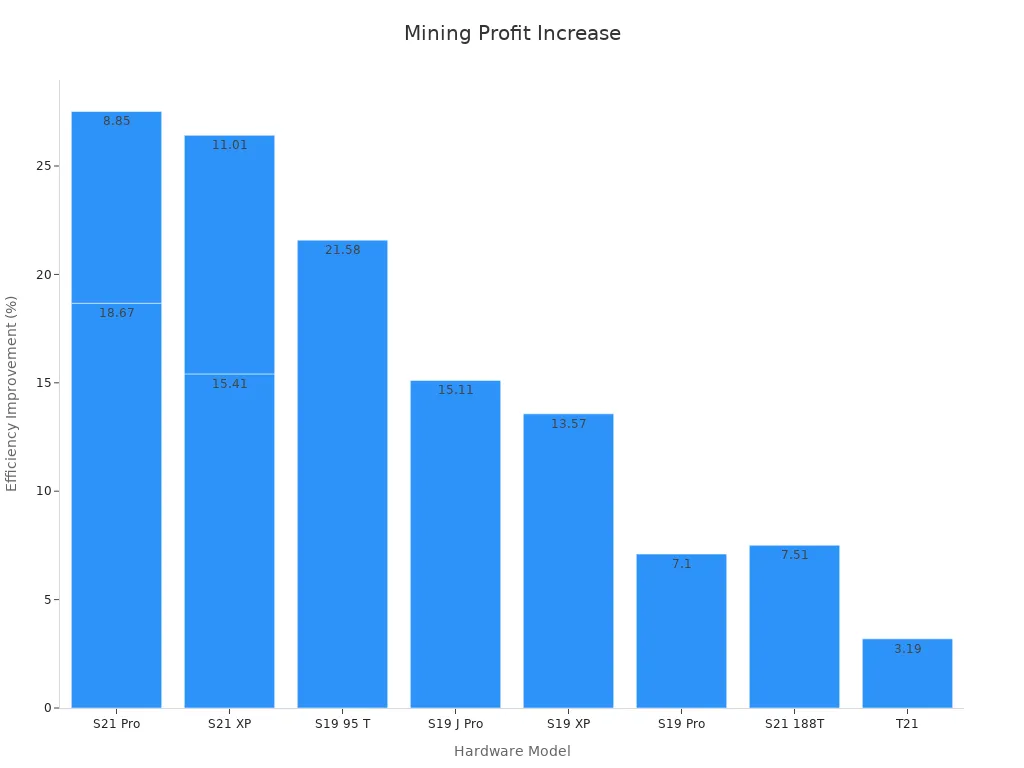
Selecting the right asic miner is the first step toward maximizing crypto mining profitability in 2025. Efficient asic mining machines deliver high hash rates while keeping power consumption low. This balance is crucial because electricity costs can quickly eat into mining profits. The table below compares popular asic models, showing how hash rate and efficiency affect mining outcomes:
A lower J/TH value means the asic miner uses less energy for each unit of mining power. This efficiency becomes even more important in regions with higher electricity prices. Cooling solutions, such as water cooling, also help maintain performance and extend the life of the asic mining machine.
Strategies for Boosting Mining Hardware’s Efficiency
Miners can boost crypto mining efficiency by choosing asic models with proven performance and reliability. The Whatsminer M20S stands out as a practical example. It offers a strong hash rate and operates efficiently in areas with low electricity costs. For instance:
MicroBT, the maker of the Whatsminer M20S, has a reputation for low failure rates and durable asic mining machines. Investing in trusted brands like MicroBT often leads to better long-term returns. The expected lifespan of an asic mining machine ranges from 6 to 10 years, especially with regular maintenance. This durability helps miners stay competitive in the fast-changing crypto market.
Mining Pools
Pool Mining vs. Solo Mining
Crypto miners often face a choice between solo mining and joining a mining pool. Solo mining gives one the chance to earn the full bitcoin block reward, but the odds are slim for most. A miner with limited hash power might wait years for a single payout. Mining pools change this dynamic. By combining hash power from many miners, a pool increases the frequency of block discoveries. Each participant receives mining rewards based on their contribution. This approach smooths out income and reduces the risk of long dry spells.
Pool Selection
Choosing the right mining pool can boost crypto profitability. Reputable pools like F2Pool support bitcoin mining and many other cryptocurrencies. F2Pool, for example, charges a 2.5% fee for its PPS+ payout method. It distributes mining rewards daily, with a minimum withdrawal of 0.005 bitcoin. The pool supports both ASIC and GPU miners, making it accessible for various crypto setups.
Key features of top mining pools:
Daily automatic payouts
Multiple payout methods (PPS+, FPPS, PPLNS)
Real-time hashrate monitoring
Strong security and transparent revenue history
The current mining rewards structure and pool features help miners adapt to market changes. By joining a mining pool, miners can track their crypto earnings, manage risk, and improve profitability in the evolving bitcoin market.
Market Trends
Price & Difficulty
Market trends play a major role in bitcoin mining. Three factors shape the landscape: bitcoin price, mining difficulty, and mining rewards. When the market price of bitcoin rises, mining rewards become more valuable. This attracts more miners, which increases mining difficulty. As difficulty climbs, miners need more computing power to earn the same rewards. If the market price drops, some miners leave, causing difficulty to fall and making mining easier for those who remain.
Bitcoin price changes directly impact the value of mining rewards.
Mining difficulty adjusts every 2,015 blocks to keep block times steady.
Higher market demand for bitcoin brings more miners, raising difficulty and balancing profits.
The ‘Golden Triangle‘ for miners includes market price, mining difficulty, and operational costs.
A study found that bitcoin mining profitability depends on these shifting factors. When electricity costs rise above a certain point, mining can become unprofitable. Miners must watch both market price and mining difficulty to stay ahead.
Profitability Calculator
Smart miners use tools to track market trends and adapt their strategies. Online profitability calculators help miners estimate daily profits based on current bitcoin price, mining difficulty, and hardware specs. These calculators update in real time, reflecting changes in market price and mining rewards. Popular options include WhatToMine, NiceHash, and Asicminervalue.
he Tracking market trends and using calculators helps miners maximize profits, choose the best crypto to mine, and plan for future growth.
How Much Can You Make Mining Bitcoin in 2025
Bitcoin mining in 2025 offers both opportunities and challenges. Several factors shape potential earnings, including hardware efficiency, electricity costs, and operational strategies. Here are the key elements that influence profitability:
Cooling Methods and Their Impact
Air cooling remains common for asic miners. It requires frequent cleaning every 2-4 weeks to prevent dust buildup, which can cause overheating and reduce miner lifespan.
Hydro cooling and immersion cooling provide better heat dissipation. These methods keep asic miners within the optimal temperature range of 10°C to 25°C, reducing noise and extending hardware life to nearly a decade.
Upgrading from air to liquid cooling can significantly improve asic efficiency and maintain stable hash rates.
Maintenance and Downtime Reduction
Regular maintenance, such as cleaning dust filters and updating firmware, prevents hardware failures and keeps asic miners running efficiently.
Monitoring temperature, fan function, and power consumption helps avoid downtime and protects against hardware damage.
Using high-quality power supplies and avoiding overclocking further reduces stress on asic hardware.
Compliance and Location
Mining regulations vary by region. Operators must comply with local laws to avoid fines or shutdowns.
The United States leads in hash rate share, but electricity costs differ widely. Strategic hosting in regions with low electricity costs remains critical for profitability.
A well-maintained asic miner, operated in a region with low electricity costs and optimal cooling, can achieve a return on investment in as little as 12 months if bitcoin prices rise. Mining remains a major revenue source, but only those who optimize every aspect of their operation will see consistent profits in 2025.
Successful mining in 2025 depends on several proven strategies.
Efficient hardware, lower electricity costs, and joining mining pools all boost mining returns.
Automation, remote control, and data-driven decisions have improved mining productivity and reduced costs in recent studies.
Mining operations that adapt to new technology and market shifts stay profitable.
Regularly reviewing mining setups helps miners find new ways to improve.
Mining companies that use active dispatching and control rooms see better communication and fewer bottlenecks.
Battery electric vehicle fleets in mining have shown lower ownership costs and higher operational gains.
Automation and AI integration in mining increase resource use and efficiency.
Mining operations that focus on sustainability, such as reducing fuel use, also cut emissions and costs.
Mining success in 2025 will come from ongoing adaptation and smart upgrades.
FAQ
What is the most important factor for mining profitability in 2025?
Electricity cost remains the top factor. Miners who secure low rates see higher profits from mining compared to those with higher energy expenses.
How often should miners perform maintenance on their mining equipment?
Miners should check and clean their mining machines every two to four weeks. Regular maintenance helps prevent overheating and extends hardware life.
Can small-scale miners still earn profits from mining?
Small-scale miners can earn profits by joining mining pools. Pools provide steady payouts and reduce the risks of solo mining.




























 Bitmain
 Iceriver
 Bitdeer
 BOMBAX
 DragonBall
 Elphapex
 Fluminer
 Goldshell
 iBelink
 Ipollo
 Jasminer
 Volcminer
 Bitcoin(BTC) Miner
 Aleo Miner
 CKB Miner
 ETC Miner

 Kaspa(KAS) Miner


 Siacoin(SC) Miner